
Before you compare AI model benchmarks
- Model selection answers what an AI system can reason about. Data sovereignty and deployment boundaries decide whether legal and IT security ever let your plant turn it on.
- Connecting a self-hosted local LLM to a cloud-hosted SaaS AI platform changes where inference runs, not where your prompts, BOMs, and tool outputs travel.
- For European manufacturers, hosting in a regional cloud zone solves physical data residency, not legal jurisdiction or control-plane dependency.
Why model selection is the second decision, not the first
Most enterprise AI evaluations in manufacturing begin with a model bake-off. Engineering teams compare reasoning scores, context windows, and token pricing across frontier models, pick a favorite, and run a pilot on exported files. Six months later, the project stalls when IT security and legal ask a question nobody put in the pilot brief: where did those inputs actually go?
In Cloudera’s The State of Enterprise AI 2026 report (based on a Wakefield Research survey of 1,500 global IT leaders fielded in September 2026 and released on October 26, 2026), 84% of respondents said data residency, sovereignty, or jurisdiction-specific requirements influence where AI workloads are deployed. More telling, 58% said moving an AI workload to meet changing requirements still requires a moderate or major redesign.
That 58% figure explains why the cloud vs on-premise AI debate in manufacturing is not a late-stage hosting detail. If your architecture assumes a public cloud endpoint and legal rejects outbound traffic for engineering or shop-floor records, you do not flip a toggle. You rebuild the integration layer, the storage layer, and often the workflows around them.
We build an AI middleware layer that supports both built-in cloud models and self-hosted endpoints, so treat the rest of this article as an architecture checklist you can apply to us as well.
What manufacturing data actually leaves the plant when you call a cloud AI
General comparisons of cloud vs on-premise AI focus on two extremes: office chatbots summarizing meeting notes, or computer-vision cameras inspecting parts at sub-50 millisecond speeds on a conveyor line. Both frames miss what happens when an AI agent connects to the core software a factory already runs.
When an AI workflow reads and acts across PLM, ALM, MES, ERP, CRM, and WMS, the payload inside each prompt and tool response is not generic text. It is the company’s operating intellectual property:
In a PLM, queries touch design search, bill of materials (BOM) structures, part substitutions, and engineering change orders (ECO/ECR).
In an ALM, prompts carry unreleased system requirements, test coverage gaps, and failure root-cause analysis.
In an MES, context includes shop-floor schedules, production exceptions, process parameters, and quality inspection records.
In an ERP and WMS, records expose supplier pricing, lead times, inventory positions, and customer fulfillment commitments.
In manufacturing, your drawings, BOMs, and process parameters are the product. Once that context leaves your network to traverse a third-party cloud pipeline, you cannot recall it from upstream logs, caches, or diagnostic traces you do not control.
Teams also underestimate what happens when official deployment stalls. When engineers wait months for an approved tool, they do not stop using AI; they start pasting real specifications into unapproved personal AI tools, creating shadow data flows with no access control or auditability.
Data residency is not data sovereignty in European manufacturing
A common workaround in European industrial procurement is asking a cloud AI vendor to host the workspace in Frankfurt, Dublin, or Paris and treating that as compliance. It solves one requirement and hides another.
Data residency defines the physical geography where data is stored at rest. Data sovereignty defines who holds legal jurisdiction and operational control over that data, the infrastructure processing it, and the logs generated around it.
A European data center operated by a non-European provider still operates under globally managed control planes, external support tooling, and the provider’s home-country legal reach, including cross-border disclosure regimes such as the US CLOUD Act. Physical proximity in an EU zone does not by itself give a German automotive supplier or a French aerospace subcontractor sovereign control over its AI execution path.
Boardrooms recognize both the urgency and the limits of full isolation. In the Capgemini Research Institute report Digital Sovereignty: From Policy Ambition to Executive Imperative (a global survey of 1,300 executives published on September 8, 2026), 93% of organizations said they have discussed digital sovereignty at the board level, while 59% said full digital sovereignty across the entire technology stack is unrealistic. Most industrial enterprises are not trying to build every chip and foundation model from scratch; they are trying to keep core IP, execution control, and vendor portability inside defensible boundaries.
Three European regulatory tracks make that architectural boundary concrete:
- The EU Data Act (Regulation (EU) 2023/2854) entered into application on September 12, 2025. Beyond expanding user rights over connected industrial machinery data, it mandates cloud switching and portability to on-premise infrastructure, capping switching charges during transition before prohibiting them entirely on January 12, 2027. Locking your AI workflows into a proprietary single-vendor cloud stack runs directly against the direction of EU data law.
- The EU AI Act (Regulation (EU) 2024/1689) has an adjusted high-risk schedule under the Digital Omnibus on AI (effective July 27, 2026): transparency rules under Article 50 and national enforcement powers took effect on August 2, 2026, while compliance deadlines for stand-alone high-risk systems (Annex III) and high-risk AI embedded in regulated products such as machinery and vehicles (Annex I) sit at December 2, 2027 and August 2, 2028. For industrial R&D cycles that run two to four years, architectures built in 2026 will be audited under those rules.
- NIS2 extends supply-chain cybersecurity accountability and strict incident-reporting timelines across critical manufacturing sectors, turning unvetted third-party AI data flows into a management-level risk item.
The local LLM trap: changing the model endpoint does not change the network path
To bridge security objections without giving up SaaS convenience, many vendors offer “bring your own local model.” On paper, it sounds clean: you deploy an open-weight model (such as Llama, Qwen, or Mistral) on your own GPU server using an OpenAI-compatible inference engine, paste the URL into a SaaS AI platform, and tell stakeholders your AI runs locally.
In practice, that setup creates a false sense of containment. Changing the model endpoint changes where inference runs. It does not change the road the data travels.
If the AI middleware, connector runtime, or chat workspace still lives in a vendor’s public cloud, three things still leave your network on every request:
- Prompt assembly and tool payloads. When the agent queries your ERP, PLM, or MES, the retrieved BOM lines, ticket text, and engineering descriptions travel up to the cloud orchestration layer first, get formatted into context windows there, and only then get forwarded to your model endpoint.
- Auxiliary model calls. Production AI platforms rarely call a single model. Title generation, conversation summarization, memory extraction, OCR, speech-to-text, embeddings, and follow-up suggestions often run on separate helper models. If only the main chat model is local while helper pipelines still call cloud APIs, fragments of proprietary data leak out silently.
- Storage, identity, and telemetry. Uploaded CAD PDFs, email attachments, conversation histories, user records, and analytics events remain in cloud databases and third-party telemetry pipelines unless those layers move inside your perimeter too.
An OpenAI-compatible local endpoint solves model choice and inference compute ownership. It only solves data sovereignty when the orchestration, storage, and account layers sit inside the same network boundary as the model.
Cloud vs on-premise AI in manufacturing: comparing the three deployment models
In real evaluations, manufacturing teams are not choosing between two options. They are choosing among three topologies with very different failure modes.
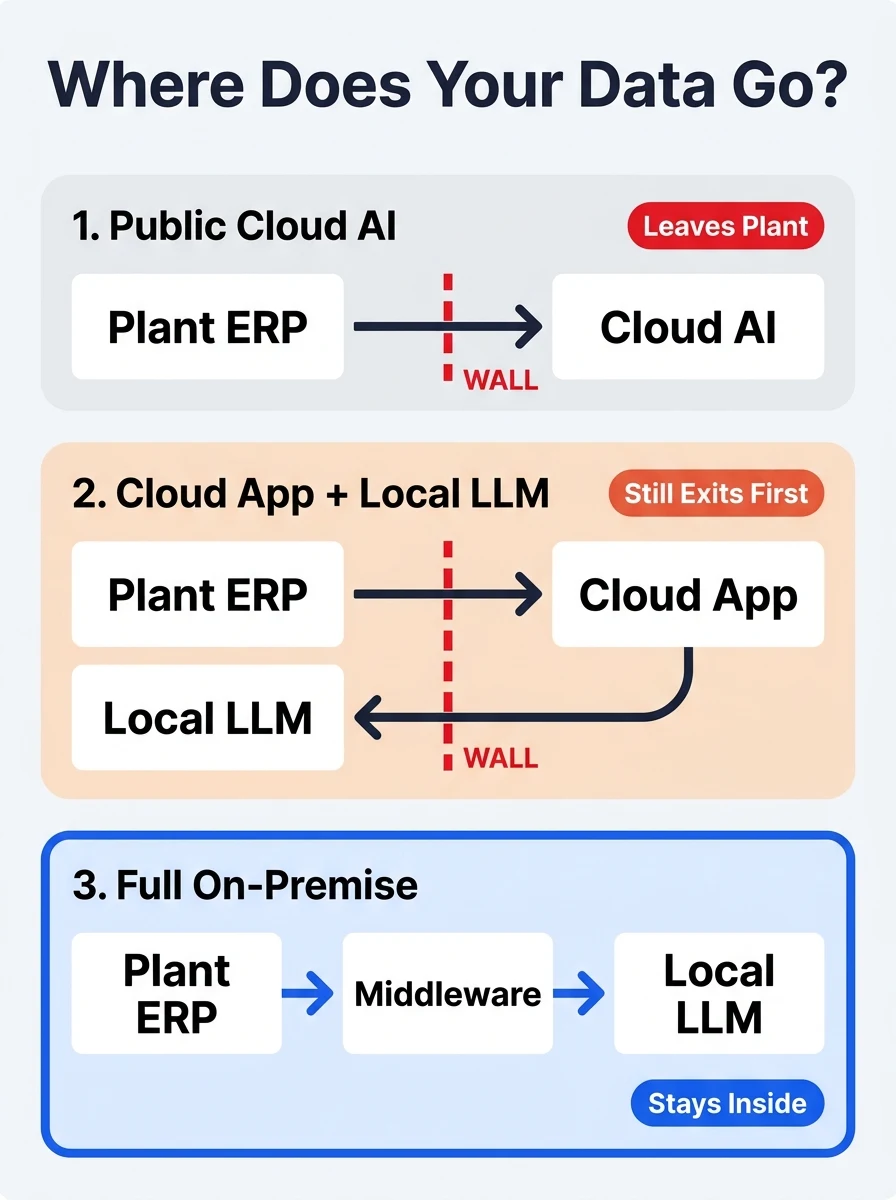
| Deployment model | Where inference runs | Where prompts, BOMs, and logs travel | Operational and cost profile | Where it breaks |
|---|---|---|---|---|
| Public Cloud SaaS AI | Multi-tenant or dedicated cloud GPUs | Leave plant network to vendor cloud and cloud LLM APIs | Fast onboarding, zero GPU CapEx, variable per-token OpEx | Fails strict IP, defense, automotive, or sovereign-perimeter reviews |
| Cloud Middleware + Local LLM Endpoint | Self-hosted GPUs via OpenAI-compatible endpoint | Still leave plant network to cloud middleware, connectors, and helper services | Preserves SaaS UI with control over primary model weights and token rates | Creates a false sovereignty claim if legal asks whether raw inputs ever leave the firewall |
| Full On-Premise / Private Deployment | Self-hosted GPUs inside plant or private VPC | Stay inside customer-controlled network (models, middleware, storage, and accounts) | Upfront hardware CapEx, internal IT ownership, predictable marginal cost | Harder initial setup, requires internal GPU capacity, and open-weight models may trail frontier cloud models on complex tasks |
Economics also shift over the life of a deployment. Cloud APIs win on day one because you pay nothing for idle hardware. Once workflows run continuously across engineering and operations, token economics flip quickly: the same Cloudera October 2026 study found that 89% of enterprises have already limited or redesigned AI use cases because of rising token consumption, and 45% have moved AI workloads in response to higher or volatile costs.
At the same time, claiming that every factory should immediately air-gap every workload ignores reality. Open-weight local models require hardware sizing, concurrency planning, and upgrade ownership, and they can still trail top cloud models on ambiguous multi-step reasoning. The practical goal is not ideological purity. It is an architecture where your connectors, permissions, and workflows do not break when a workload has to move from cloud to on-premise, or from one model to another.
How Mapping Intelligence approaches local models and private deployment
Mapping Intelligence sits as an AI middleware layer over existing industrial software, including ALM, PLM, MES, ERP, CRM, and WMS, so teams do not have to replace core systems to adopt AI. You can review the core architecture on our solutions page.
Because deployment boundaries decide whether a pilot survives security review, we separate model selection from deployment perimeter rather than treating them as the same setting:
- Multi-LLM support with Local Model Support. Teams can switch across built-in cloud models or integrate their own locally deployed, OpenAI-compatible model endpoints without rebuilding workflows or connectors. That directly addresses vendor lock-in and rising token costs across teams.
- Clear distinction between endpoint and full perimeter. As we laid out in our private deployment overview video, plugging in a local model endpoint only changes where inference happens; keeping the whole map inside your walls requires deploying the full stack locally, covering models, storage, and user accounts. That is why we offer private deployment alongside our cloud workspace rather than pretending a SaaS tenant keeps data inside your building.
- Governance independent of hosting. As we covered in our guide to AI agent write access in ERP, moving a model on-premise does not automatically tell you who is allowed to change a released record. Per-member and per-role access controls over models, connectors, and features, plus token usage visibility across teams and APIs, remain part of the same control layer regardless of where inference runs.
What we do not claim: deploying on-premise does not eliminate infrastructure work. Your IT team still has to size local compute, prepare internal model endpoints, and ensure network reachability to internal industrial systems. A vendor who claims private enterprise AI requires zero IT coordination is skipping the hard part of the conversation.
Five architecture questions to settle before you sign an AI contract
Before comparing another model leaderboard, run any shortlisted AI vendor, including us, through five architectural checks:
- Trace the entire packet path, not only the model call. Ask for a diagram showing every hop from your ERP, PLM, or MES to the user interface, vector store, logs, and LLM.
- Audit the auxiliary models. Ask whether summarization, OCR, speech transcription, embeddings, and memory extraction run on the same local endpoint or silently fall back to external APIs.
- Separate physical hosting from legal control. If the vendor offers an “EU cloud” option, ask where the control plane, support access, and corporate jurisdiction reside.
- Test portability before lock-in. If you start in the cloud to validate one workflow and later move to on-premise, do your connectors, skills, and permissions survive without rewriting the integration?
- Confirm how write authority works inside the firewall. Running locally protects confidentiality, not data integrity. Check whether writes to systems of record still require scoped roles and named human approval.
FAQ
What is the difference between data residency and data sovereignty for manufacturing AI?
Data residency refers to the physical location where data is stored, such as an EU cloud data center. Data sovereignty refers to who holds legal jurisdiction and operational control over how data is processed, accessed, and governed. A non-European cloud provider hosting servers in Frankfurt satisfies residency, not necessarily sovereignty.
Does connecting a local LLM to a cloud AI platform keep manufacturing data on-premise?
No. If the AI middleware, connector service, chat storage, or auxiliary pipelines (such as OCR, summarization, or telemetry) run in a vendor’s cloud, your ERP, PLM, and MES data still leaves your network before reaching the local model endpoint. Keeping data inside your walls requires the orchestration and storage layers to sit inside the same perimeter as the model.
When should a manufacturer choose full on-premise AI instead of cloud AI?
Choose full on-premise deployment when workflows touch proprietary CAD, BOMs, process parameters, unreleased ALM specs, or regulated defense and automotive programs where outbound traffic is prohibited, or when plant-floor operations cannot depend on external internet links. Cloud SaaS fits early non-sensitive sandboxes, public marketing workflows, or cross-region tasks with explicit legal clearance.
Can manufacturers switch between cloud and local AI models without rebuilding workflows?
Yes, if the AI middleware decouples workflow orchestration and system connectors from the underlying model provider through OpenAI-compatible interfaces and consistent access controls. Under the EU Data Act, avoiding proprietary single-model and single-cloud lock-in is increasingly both an architectural best practice and a compliance safeguard.
Evaluating cloud vs on-premise AI for your manufacturing stack? Write to us at support@mappingintell.ai to ask about local model endpoints or private deployment.